5 Simple Fingerpicking Patterns For Acoustic Guitar
by Simon Candy
 One of the biggest misconceptions about fingerpicking guitar is that you need complicated patterns and advanced techniques to create beautiful music.
It's easy to get caught up in learning different finger combinations, developing thumb independence, and trying to master increasingly difficult patterns.
But here's the thing.
Some of the most beautiful fingerpicking sounds come from surprisingly simple ideas. What makes them interesting isn't necessarily the pattern itself. It's how you apply that pattern to music.
In this lesson, we'll explore five simple fingerpicking patterns that are comfortable to play but can produce rich, expressive sounds. And more importantly, we'll look at how you can use them to create music rather than simply practise exercises.
Watch the video below to learn more:
Pattern 1
Our first pattern uses your thumb and all 3 fingers:

The pattern is simply:
p – i – m – a
That's it.
On its own, it might not sound particularly exciting. But let's see what happens when we apply it to a chord progression.
Rather than playing full open or barre chords, we'll use small two-note shapes known as 10th harmonies.
These shapes come directly from familiar barre chord positions, but we're only playing two notes from each chord.
We'll also include the top two open strings in our picking pattern.
This creates a lovely combination of moving chord tones and ringing open strings:
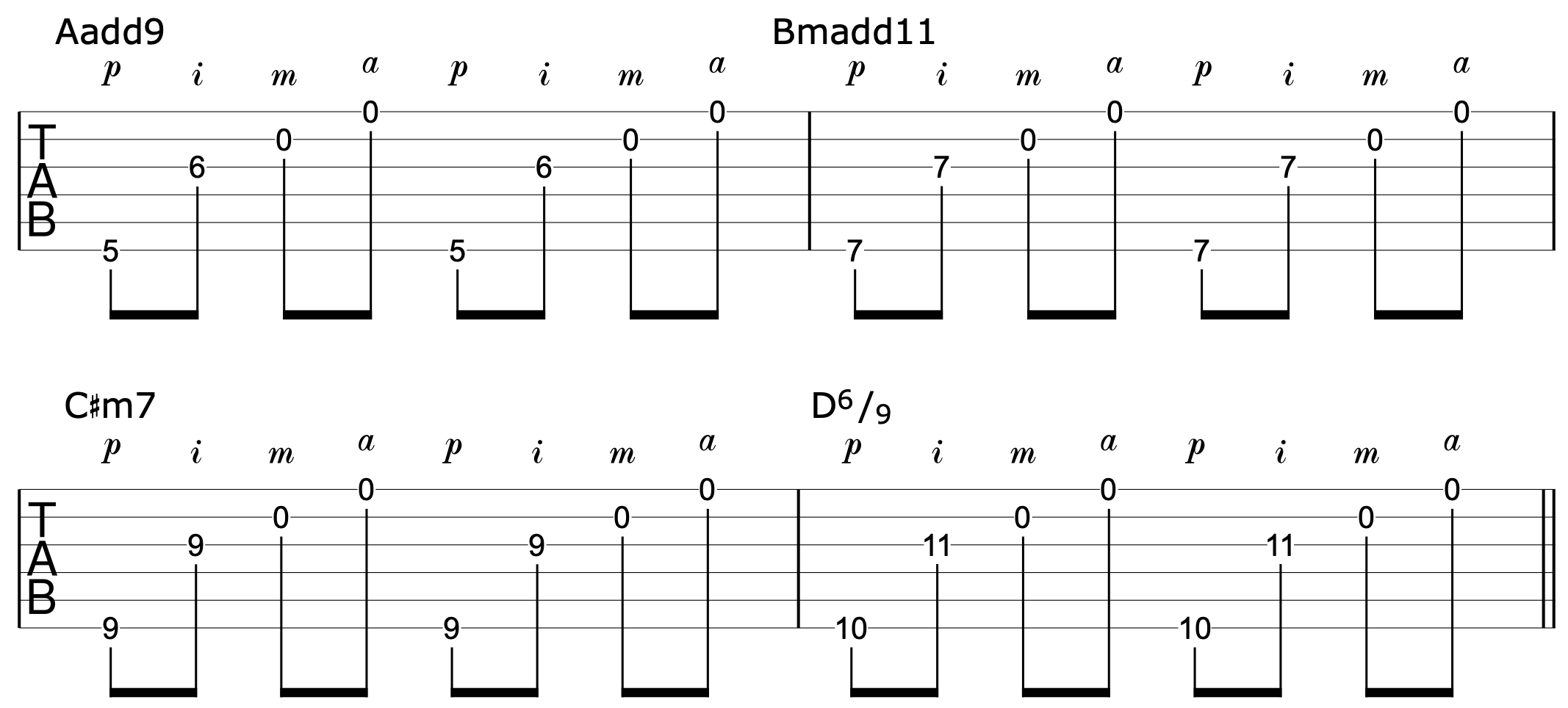
As you move through the progression, you'll hear how these simple shapes create a much fuller sound than you might expect.
And because you're only fretting two notes at a time, the chord changes are relatively easy.
It's a great example of how a basic fingerpicking pattern, combined with thoughtfully chosen notes, can create something beautiful.
Pattern 2
For our second pattern, we're going to make things even simpler.
This time, you'll only need your thumb and index finger:

The pattern is:
p – i – p – i
Start by alternating between the open 6th and 2nd strings.
Keep a steady eighth-note rhythm and allow the notes to ring naturally.
Now let's apply this to a chord progression.
Rather than playing complete chords, we'll imply each chord using just two notes.
Your thumb plays the root note of the chord, while your index finger plays another note belonging to that chord:
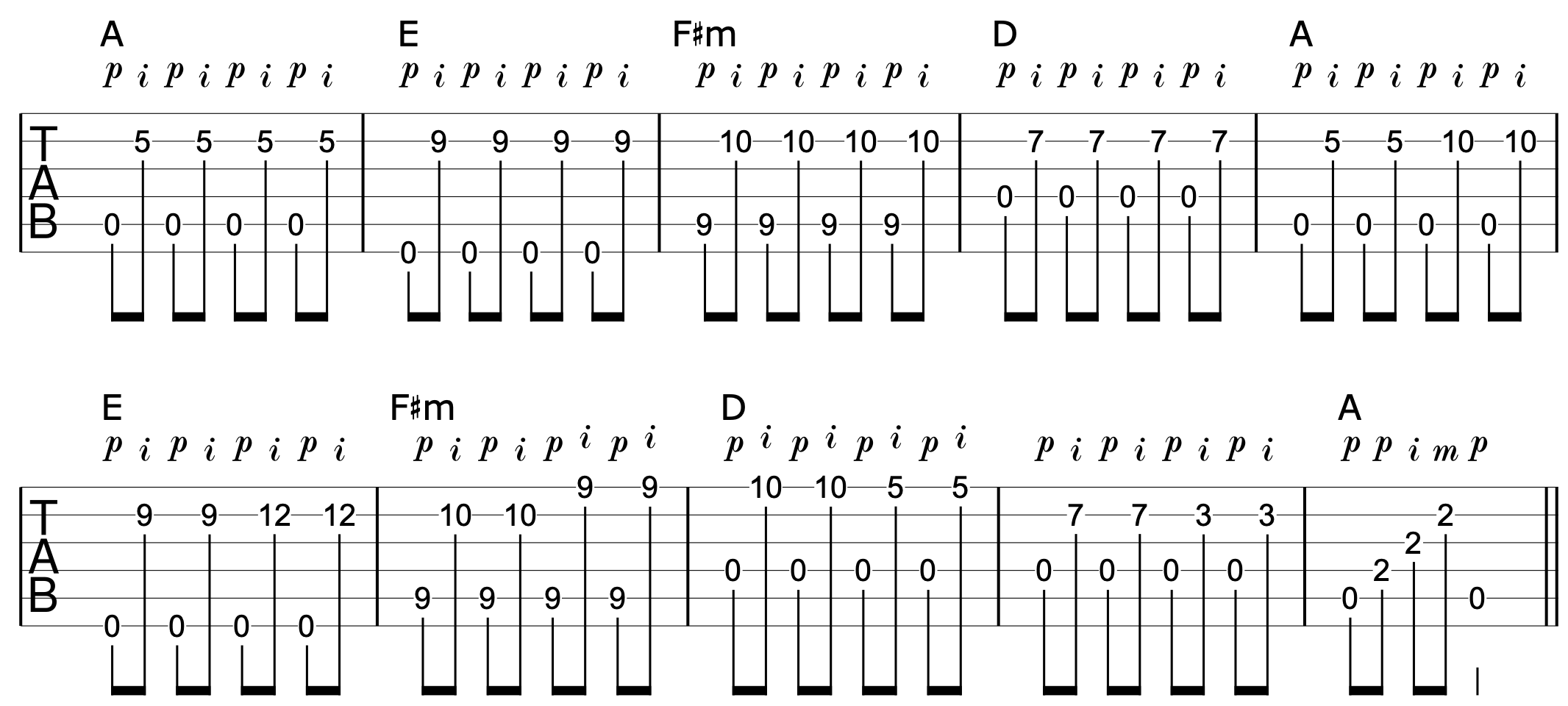
Even though you're only playing two notes at a time, the progression is clearly recognisable.
And it has a lovely, spacious quality.
Pattern 3
Our third pattern introduces a slightly different sound.
This is one of those simple fingerstyle patterns that can create a surprisingly full sound with very little movement.
Start by plucking the open 4th and 1st strings together using your thumb and middle finger.
Then pluck the open 3rd string with your index finger, like so:
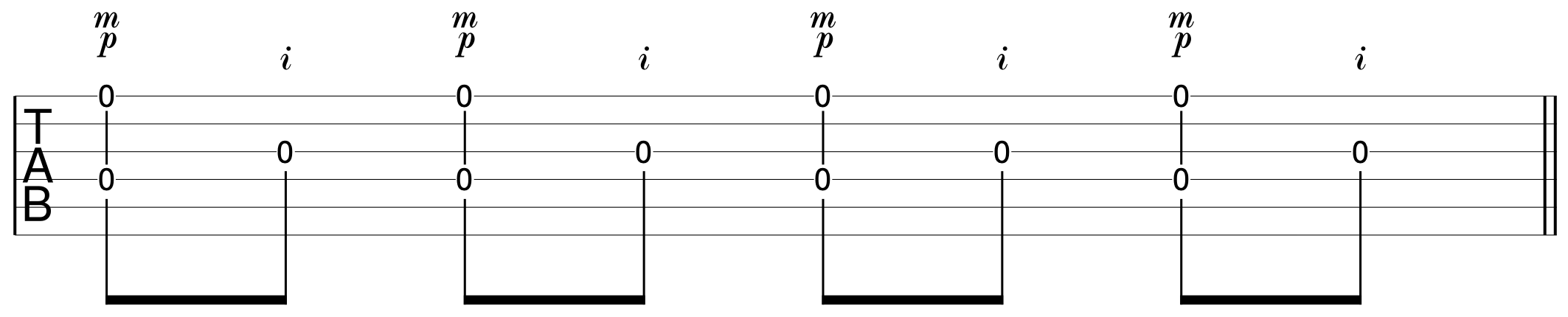
So the pattern becomes:
p/m - i
Let's apply it to a familiar chord progression from Pachelbel's Canon.
Instead of playing full chords, we'll use small harmony shapes that move down the neck.
Most of these are based around 10th harmonies, similar to our first example.
Pinch the two notes of each shape together, then follow with the index finger:
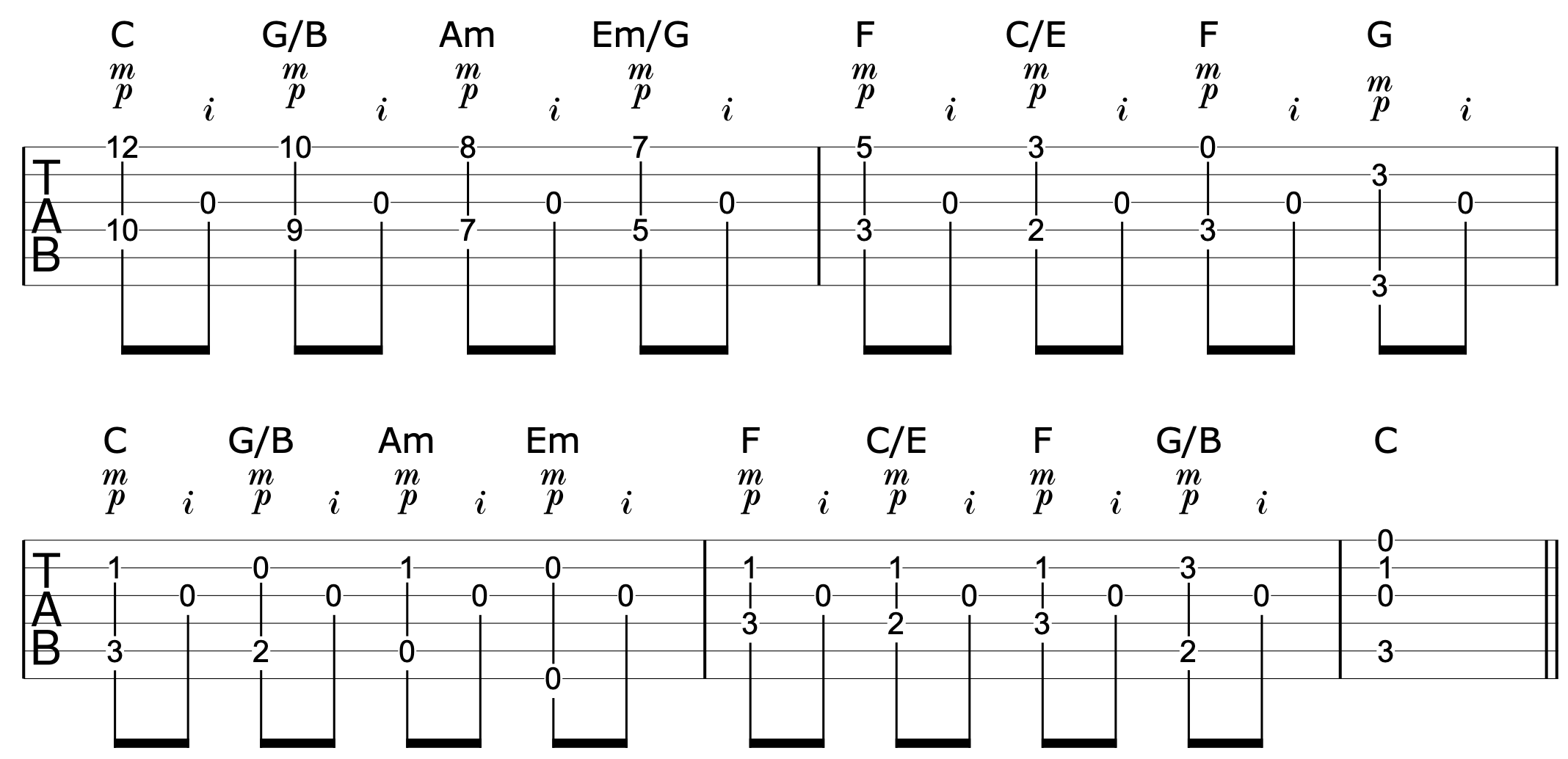
As the progression moves down the fretboard, you'll hear the harmony changing while the picking pattern remains the same.
Eventually, you'll arrive at familiar open-position chord shapes.
This is a wonderful way to create a flowing arrangement without needing a complicated picking technique.
The movement comes primarily from the changing harmony.
Your picking hand simply provides a consistent pattern that holds everything together.
Pattern 4
Our fourth pattern also uses the thumb and index finger, but this time we're going to give them different jobs.
Your thumb will play a melody on the lower strings.
Meanwhile, your index finger will repeatedly pluck the open high E string between the melody notes.
This creates a lovely effect where the melody moves underneath a repeating higher note.
Start by alternating your thumb with your index finger on the open 1st string.
Keep that upper note consistent while your thumb moves between different bass strings, like so:

Once you're comfortable, try creating a simple melody with your thumb.
Here is an example:
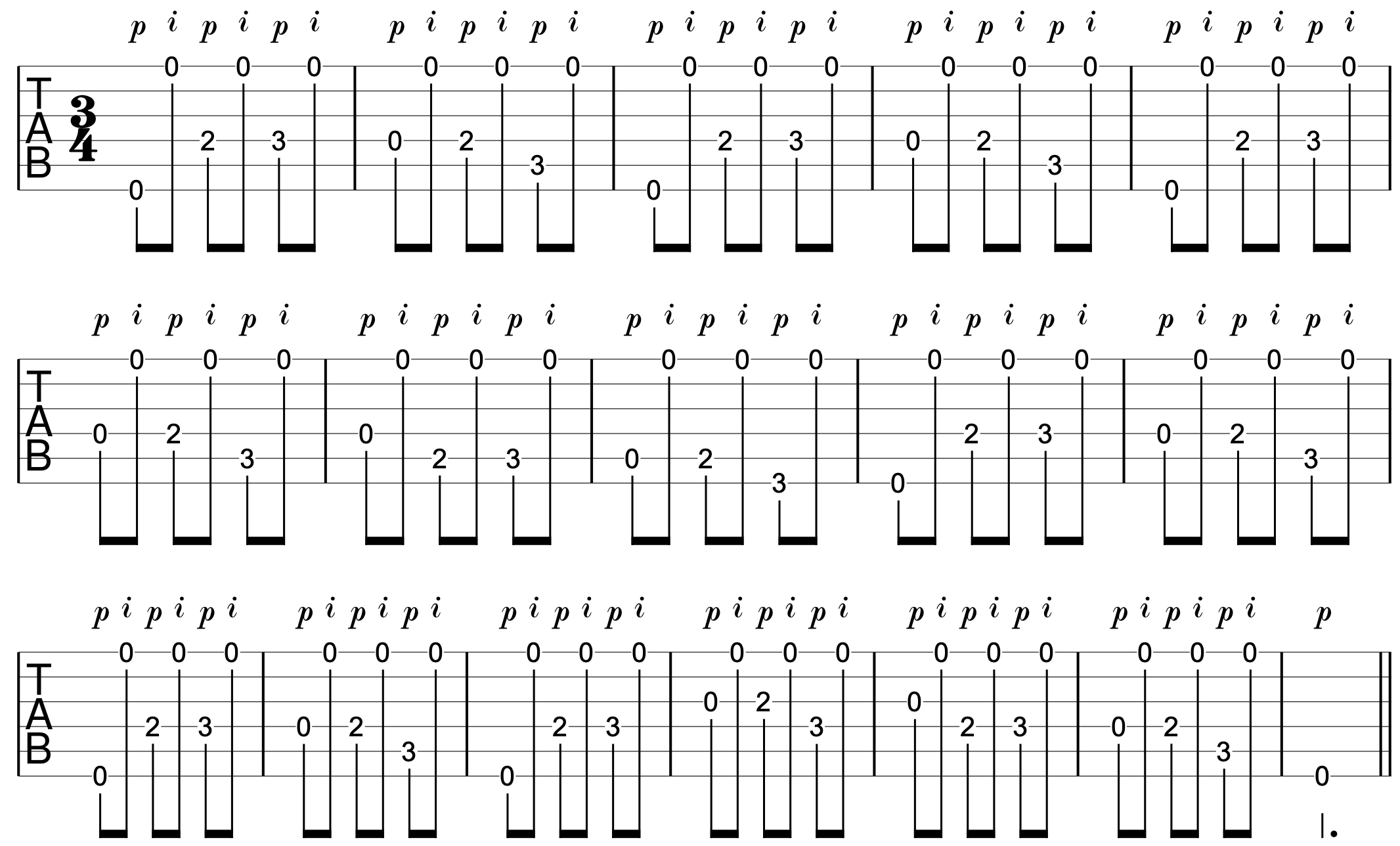
The music is played in 3/4 time, giving it a gentle Spanish character.
What's particularly interesting is that your picking hand isn't doing anything complicated.
It's still just alternating between thumb and index.
But because the thumb is playing a melody while the upper string continues ringing, the result sounds much more involved.
Try practising the thumb melody on its own first.
Then add the repeated high E string between each melody note.
You'll quickly hear how these two simple parts work together to create something much fuller.
Pattern 5
Our final pattern uses the thumb and three fingers again, but this time we'll play six notes in each cycle.
Start on the open strings with the following sequence:

So the pattern becomes:
p – i – m – a – m – i
This is a very common fingerpicking pattern in 6/8 time.
It has a naturally flowing quality that works beautifully with slower, expressive chord progressions.
Let’s apply it to a progression:
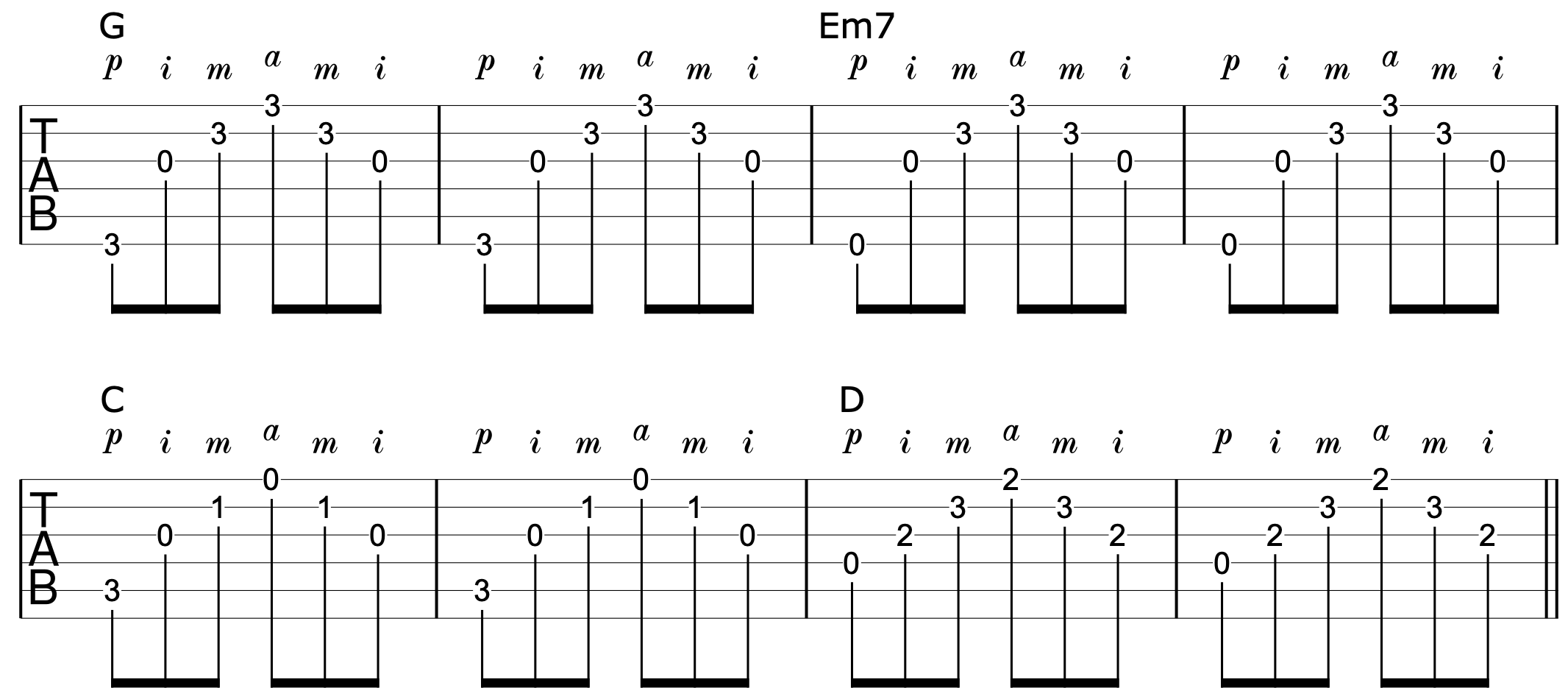
One particularly nice feature of this progression is the movement from G to Em7.
You can keep most of the chord shape in place, allowing the upper notes to continue ringing as the bass changes underneath.
This gives the progression a smooth, connected sound.
And once again, the picking pattern itself remains unchanged.
How To Bring Simple Fingerpicking Patterns To Life
We've covered five different fingerpicking patterns for guitar, from simple two-finger movements to flowing six-note sequences.
But the most important lesson isn't really about the patterns themselves.
It's about what you do with them.
A basic picking sequence can sound completely different depending on the chords, harmony shapes, and melodic ideas you combine it with.
And that's where fingerstyle guitar becomes really interesting.
Rather than constantly searching for more complicated patterns, spend some time exploring what you can create with the simple ones you already know.
Take one of the examples from this lesson and get it comfortable under your fingers.
Then try changing the chord progression, moving a few notes around, or creating your own variation.
You might be surprised by how much music you can get out of such a simple idea.
Frequently Asked Questions
What are the easiest fingerpicking patterns for beginners?
Some of the easiest patterns involve alternating between your thumb and index finger or picking strings in a simple sequence such as thumb, index, middle, and ring. These are excellent starting points because they're easy to remember and can be applied to many different chord progressions.
How do I make simple fingerpicking patterns sound better?
Focus on how you apply the pattern rather than making it more complicated. Try using different chord shapes, allowing open strings to ring, or changing a few notes within a progression. Small musical changes can make a simple pattern sound much more interesting.
How long does it take to learn fingerpicking guitar?
It depends on your experience and how regularly you practise. You can begin playing simple fingerpicking patterns quite quickly, but developing smooth chord changes, consistent timing, and finger independence takes longer. Regular, focused practice is more useful than rushing into difficult patterns.
What is a 6/8 fingerpicking pattern?
A 6/8 fingerpicking pattern groups six notes into a repeating cycle, often creating a flowing, gently rolling feel. A common example is thumb, index, middle, ring, middle, index. It works particularly well with slower progressions.
Do I need to learn lots of fingerpicking patterns?
No. A small collection of patterns can give you plenty of musical possibilities. Learning how to apply a few simple patterns to different chords, melodies, and rhythms is often more valuable than memorising dozens of patterns without knowing how to use them.
Other Lessons You Might Like
Explore these related lessons to continue building your guitar skills:
Discover More Easy Fingerpicking Patterns for Guitar
Discover more simple fingerpicking ideas you can use to make simple chord progressions sound more interesting.
Learn How To Fingerpick Guitar In 6/8 Time
Take the flowing sound of pattern five further with additional ways to apply 6/8 fingerpicking to your playing.
Discover The Magic Of The Bossa Nova Fingerpicking Pattern
Learn the cool groove and vibe of the Bossa Nova Fingerpicking Pattern and how to apply it to your playing.
Learn The Power Of 3 When Fingerpicking
Discover how to simplify your fingerpicking with the power of 3.
Discover The Top 5 Travis Picking Patterns For Guitar
Learn the 5 most common travis picking patterns that will get you through thousands of songs on guitar.

Master Fingerpicking Guitar Step by Step
Build solid technique, develop confidence, and learn to create beautiful fingerpicking music with a structured course that takes you from the basics to more advanced playing.