How to Make Amazing Grace Sound More Expressive with Natural Harmonics
by Simon Candy
 Have you ever learned an Amazing Grace fingerstyle guitar arrangement that sounds perfectly fine, but somehow lacks the beauty and expression you hear when someone else plays it?
You're playing the same melody. You're using the same chords. Yet their version seems to have more space, more movement, and a richer sound.
Very often, the difference isn't a more difficult fingerpicking pattern or more advanced chord shapes.
It's the way the notes are played.
In this arrangement of Amazing Grace, we'll use natural harmonics, open strings, and a little more space between the notes to transform a familiar tune into something much more expressive.
Better still, these are ideas you can borrow for your own fingerstyle guitar arrangements, not just this one.
Watch the video below to learn more:
Amazing Grace
Here is the arrangement of Amazing Grace:
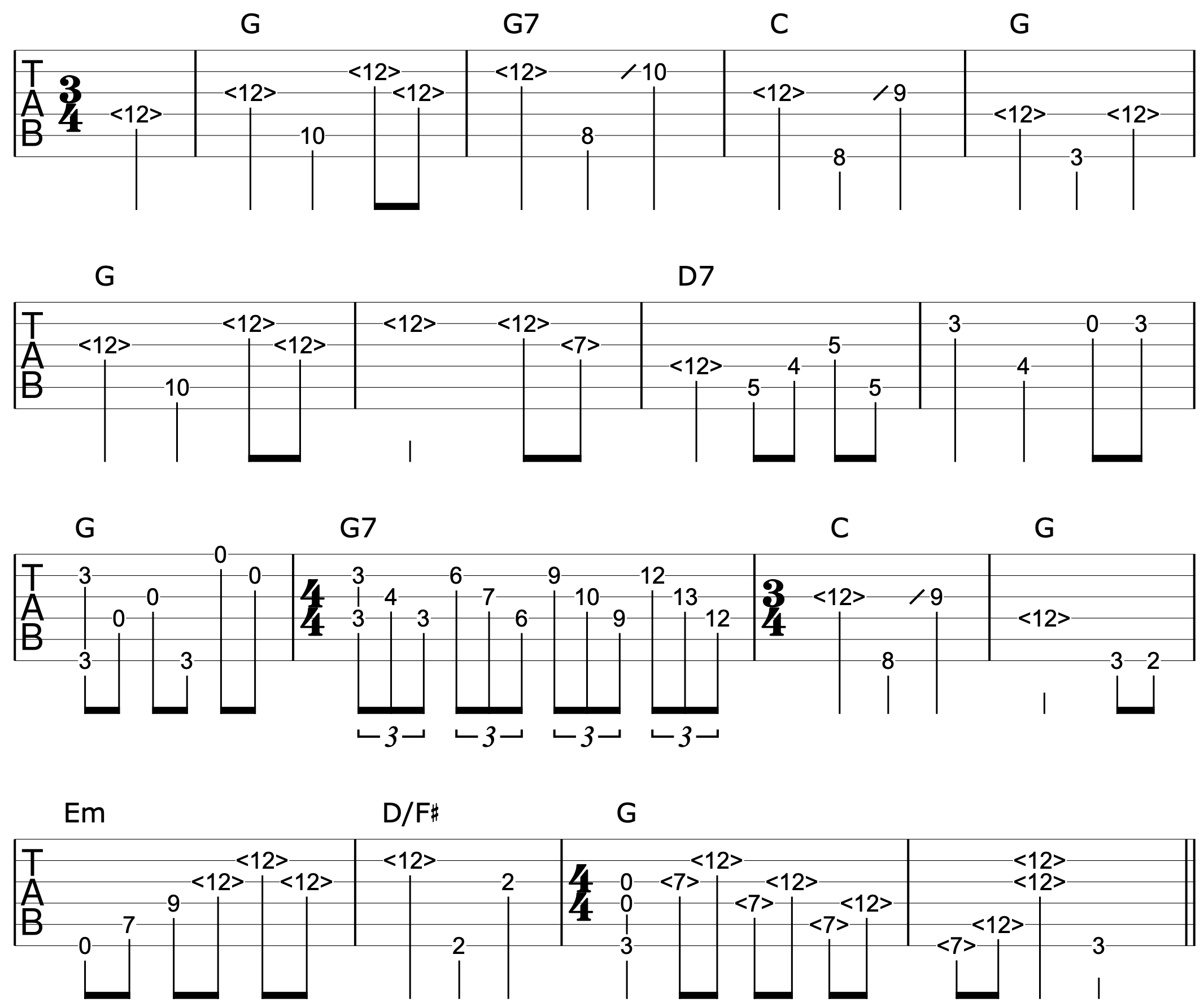
Be sure to watch the video above for a detailed breakdown of this arrangement.
Start with the Melody
Whenever you're arranging a tune, it's helpful to separate the melody from everything else.
The melody is the part people recognise.
The accompaniment simply supports it.
In the opening phrase of Amazing Grace, there isn't a great deal of accompaniment.
Instead, the melody takes centre stage, allowing each note plenty of room to ring.
That alone creates a much more relaxed and expressive sound than filling every moment with chords.
Sometimes, playing less really does sound like more.
Use Natural Harmonics to Create a More Expressive Sound
One of the defining sounds in this arrangement is the use of natural harmonics.
Unlike a fretted note, a natural harmonic has a bright, bell-like quality that seems to hang in the air.
Instead of simply playing every melody note in the usual way, some of them are replaced with harmonics wherever possible.
The result is immediate.
The melody becomes lighter, more spacious, and much more distinctive.
Not every note can be played as a harmonic, and that's actually part of the charm.
The contrast between the harmonics and the regular fretted notes creates a lovely change in tone throughout the arrangement.
Leave Space Between the Chords
Another thing that gives this arrangement its character is how little accompaniment there actually is.
Rather than playing full chords throughout, the harmony is often suggested with a single bass note or a simple movement between chord tones.
Your ear naturally fills in the rest.
This leaves plenty of room for the melody and the harmonics to resonate without everything competing for attention.
The arrangement feels open instead of crowded.
Let the Notes Ring Naturally
It's easy to become obsessed with keeping perfect time.
But if you want to make your guitar sound more expressive, music often benefits from a little freedom.
Rather than treating every beat exactly the same, allow important notes to ring a little longer before moving to the next phrase.
You're not abandoning the rhythm.
You're simply letting the music breathe.
That small change can make a familiar tune feel much more natural and emotional.
Know the Harmony Behind the Melody
One useful habit when creating a fingerstyle guitar arrangement is to always know which chord is underneath the melody.
Even if you're only playing a single melody note at that moment, the harmony is still there.
Understanding where the melody sits against the chords helps you choose accompaniment that supports the tune without overwhelming it.
Sometimes that might be a complete chord.
Other times, it might only be a single bass note.
Both approaches can work beautifully.
Build the Arrangement Gradually
One reason this arrangement feels interesting from beginning to end is that it doesn't reveal everything straight away.
The opening phrases are very sparse.
Later, more chord fragments begin to appear.
Small connecting ideas are added between phrases.
The arrangement gradually becomes fuller before settling back into a simple ending.
That sense of development keeps the listener engaged without making the piece feel complicated.
When you're arranging songs yourself, think about creating the same kind of journey.
Finish with a Sense of Resolution
The final phrase continues the same ideas that have been introduced throughout the arrangement.
Natural harmonics return.
Simple bass movement connects the harmony.
A short melodic run leads naturally to the final G chord.
Nothing flashy.
Nothing overplayed.
Sometimes the most memorable endings are the simplest ones.
Frequently Asked Questions
How do natural harmonics make a guitar arrangement sound better?
Natural harmonics produce a clear, bell-like tone that adds contrast and colour to a melody. Used sparingly, they can make a fingerstyle arrangement sound more expressive without making it more difficult.
Is this Amazing Grace arrangement suitable for intermediate players?
Yes. While the arrangement includes natural harmonics and expressive phrasing, the techniques are well within reach of most intermediate fingerstyle guitarists who are comfortable changing chords and playing melodies.
Should I play full chords all the way through a fingerstyle arrangement?
Not necessarily. Often, a single bass note or a few chord tones are enough to suggest the harmony, leaving more space for the melody to stand out.
How can I make my fingerstyle guitar playing more expressive?
Focus on letting notes ring, creating space between phrases, varying your dynamics, and understanding the harmony beneath the melody. Small musical decisions often have a bigger impact than adding more notes.
Can I use these arranging ideas in other songs?
Absolutely. These ideas work well in hymns, folk songs, and many acoustic fingerstyle arrangements. Once you understand the principles, you can apply them to almost any melody.
Other Lessons You Might Like
Explore these related lessons to continue building your guitar skills:
Natural Harmonics on Guitar
Learn how to produce clean, ringing harmonics and discover where they can be used in your own arrangements.
Easy Amazing Grace Fingerstyle
If this arrangement feels a little advanced, start with this simpler version before adding more expressive ideas.
Amazing Grace with Arpeggios
See how simple arpeggios can transform the same melody into a smoother, more flowing fingerstyle arrangement.
Chord Melody Exercises and Drills
Develop the skills needed to combine melody and harmony more naturally in your own arrangements.
Danny Boy Solo Guitar Tutorial
Apply these same arranging ideas to another well-known melody while developing your fingerstyle playing further.
 Learn Fingerstyle Guitar Step by Step
Build the skills to create beautiful fingerstyle arrangements with structured lessons, personal support, and clear guidance from the ground up.