How To Create Music On Guitar Using 3rd Harmony
by Simon Candy
 Have you ever played through a chord progression and felt that something was missing?
The chords sound fine, your timing is good, but the whole thing feels a little plain.
It's tempting to think you need more complicated chords or some advanced technique to make things more interesting.
But sometimes, just two notes are enough to make a big difference.
By using double stops on guitar, you can take small pieces of chord shapes you already know and turn them into beautiful little melodies, adding movement and interest to familiar progressions.
One particularly useful approach involves something called 3rd harmony.
And while the name might sound a little technical, the idea is actually quite simple.
Watch the video below to learn more:
What Are Double Stops On Guitar?
A double stop is simply two notes played together.
Rather than playing an entire chord, you're taking just two notes and using them to create something musical.
One particularly useful type of double stop involves notes that are a third apart.
These are called thirds, and they can be either major or minor.
Now, you don't need to get too caught up in the theory here.
The important thing is that these two-note combinations sound great together, and by moving between them, you can create some really interesting musical ideas.
You can also combine them with open strings, allowing those strings to ring underneath or above the fretted notes.
This gives you a much bigger sound than you might expect from just two notes.
And because these shapes can be found within familiar chord forms, you're not necessarily learning something completely new.
You're simply discovering another way to use what you already know.
How To Play Double Stops Using 3rd Harmony
Let's look at how these two-note shapes work together.
We'll use the key of C major, which contains the notes:
C – D – E – F – G – A – B
Each note of this scale has a chord associated with it.
And within those chords, we can find the two-note combinations we're looking for.
We'll begin by mapping out the 3rds on the fifth and fourth strings of the guitar:

Notice how the shape changes slightly.
That's because the distance between the two notes is different.
As we continue moving through the C major scale, we use different combinations of these major and minor third shapes.
And this is where things become particularly useful.
Learn The Pattern Behind Major And Minor Thirds
Rather than treating every two-note combination as something separate to memorise, there's a simple pattern you can follow.
When harmonising a major scale in thirds, the sequence is:
Major – Minor – Minor – Major – Major – Minor – Minor
After the first major shape, you have two minor shapes, followed by two major shapes, and then another two minor shapes.
Once you recognise this pattern, navigating the fretboard becomes much easier.
You're no longer trying to remember a collection of unrelated guitar double stops.
Instead, you understand how the shapes connect.
And the great thing is that this sequence works in any major key.
You can also apply it to different pairs of strings.
So rather than learning the same thing over and over again, you're learning one musical idea that can be used in all sorts of situations.
Use Double Stops To Add Movement To Chords
Now, knowing the shapes is one thing.
But the real value comes from being able to use them to create music.
Imagine you're playing a C chord for a couple of bars.
You could simply strum that chord and let it ring.
Nothing wrong with that.
But what if you wanted to create a little movement without actually changing the chord?
This is where double stops in chords and progressions can be particularly effective.
Instead of staying on the same chord shape, you can move through some of these two-note combinations, creating a little melodic line, for example, like this:

And because the notes are harmonised in thirds, you're effectively playing two melodies together.
One note moves along with the other, creating a much richer sound than a single-note line.
You could use this as a chord embellishment, create a little fill between vocal phrases, or develop a short instrumental passage.
The underlying harmony might stay exactly the same.
But suddenly, there's something much more interesting happening above it.
Combine Guitar Thirds With Open Strings
Another great way to use these shapes is to combine them with open strings.
This works particularly well on acoustic guitar, where ringing open strings can add a lovely sense of space and resonance.
For example, in the key of C major, the notes of the open strings all belong to the key:
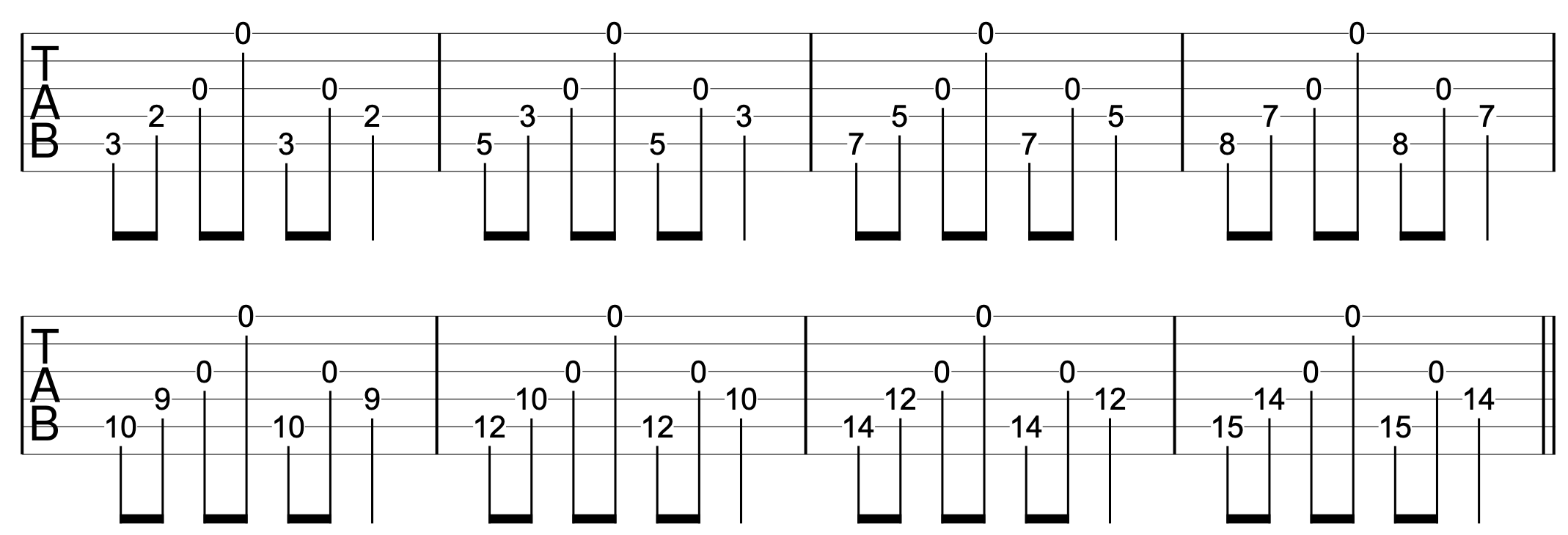
That gives you plenty of opportunities to experiment.
Try moving through some of your major and minor third shapes while allowing suitable open strings to ring alongside them.
You'll find that even these small two-note shapes can produce some surprisingly full sounds.
And because the open strings continue ringing as the fretted notes move, you get a lovely contrast between the stationary notes and the moving harmony.
Of course, not every open string will work equally well in every situation.
So let your ears guide you.
Listen to how the notes interact, and pay attention to which combinations create the sounds you like.
Use Double Stops To Complement Other Guitar Parts
Third harmony is also particularly useful when playing alongside another guitarist or accompanying a singer.
Imagine another guitarist is strumming a simple C chord.
Rather than doubling what they're playing, you could add a little movement using thirds.
You might begin with a two-note shape that outlines the C chord, move through a few nearby shapes, and then return to where you started:

The result is a small counter melody that complements the original guitar part.
You're not competing with the chords.
You're adding something around them.
And this can work just as well underneath a vocal, where a few carefully placed notes can add interest without getting in the singer's way.
It's a great example of how playing fewer notes can sometimes make the overall music sound much bigger.
A Simple Way To Practise Guitar Double Stops
One of the best ways to get comfortable using these shapes is to practise them over a single chord.
For example, record yourself strumming a C chord for a couple of minutes.
Then play the recording back and experiment with different third harmony shapes over the top.
Start with a shape that belongs to the C chord.
Move to a nearby shape, then another, and listen to how each one sounds against the underlying harmony.
Try moving up the fretboard, then back down again.
You don't need to create anything particularly complicated.
Even a short line using two or three shapes can sound great, like the examples above.
The important thing is to start hearing how these shapes work together, rather than simply practising them as an exercise.
And as you become more comfortable, try moving the same idea to another string set or a different key.
You'll begin to recognise the same patterns appearing in different places.
Frequently Asked Questions
What are double stops on guitar?
Double stops are two notes played at the same time. They can be used to create harmonies, melodic fills, riffs, and more interesting rhythm guitar parts without playing full chords.
What's the difference between major and minor third double stops?
Both use two notes, but the distance between those notes is different. A major third spans four semitones, while a minor third spans three. This gives each shape a slightly different sound.
How do I use double stops in chord progressions?
You can move between double-stop shapes to create melodic lines around the chords. Try playing them over a single chord first, then experiment with adding them between chord changes or alongside another guitarist.
Can I use double stops on acoustic guitar?
Absolutely. Double stops work particularly well on acoustic guitar, especially when combined with ringing open strings. They can add movement, harmony, and texture to both rhythm and fingerstyle playing.
Do I need to know music theory to play double stops?
No. Understanding major and minor thirds can help you recognise how the shapes connect, but you can start by learning a few shapes and experimenting with how they sound over familiar chords.
Other Lessons You Might Like
Explore these related lessons to continue building your guitar skills:
Learn More Ideas For 3rd Harmony On Guitar
Develop your understanding of third harmony and how these two-note shapes work across the fretboard. A useful companion lesson if you want to explore the foundations in more detail.
Explore 6th Harmony On Guitar
Discover another way to harmonise notes on guitar, giving you additional sounds and possibilities for creating melodic lines.
How To Create Rich 10th Harmony Sounds
Explore wider-spaced harmonies that can add depth and richness to your guitar arrangements.
How To Make Chord Progressions More Musical
Learn additional ways to turn familiar chord progressions into more interesting guitar parts using movement, variation, and musical ideas.
Play Chords Higher Up The Fretboard Up
Discover how moving beyond familiar open chord positions can give you fresh sounds and more options for your rhythm guitar playing.
 Build Your Fingerpicking Skills Step By Step
Discover a structured approach to fingerpicking that helps you develop solid technique, play more musically, and build the confidence to fingerpick the songs you love.