How To Bring Your Fingerpicking Riffs To Life With A Steady Bass
by Simon Candy
 Have you ever played a fingerpicking pattern or riff that sounds perfectly fine, but somehow feels a little empty?
You’re playing the right notes. Everything is working. But it doesn’t have that full, complete sound you hear when a good fingerstyle player seems to have several things happening at once.
One of the simplest ways to create that sound is to add a steady bass underneath what you’re already playing.
Once your thumb can lock into that bass, your fingers are free to play melodies and riffs over the top without losing the groove. It can make relatively simple ideas sound much bigger than they really are.
The key is developing enough finger independence on guitar that your thumb and fingers can comfortably handle different jobs.
In this lesson, you’ll learn how to:
- Keep a steady bass while your fingers play different rhythms
- Build thumb and finger independence without complicated exercises
- Make simple riffs sound fuller and more musical
- Turn coordination exercises into ideas you can actually use in your playing
Watch the video below to learn more:
Start With Two Simple Fingerpicking Parts
Before trying to play riffs over a steady bass, it helps to strip everything back.
For the melody part, use an open-position E minor pentatonic scale, starting from the E note on the second fret of the fourth string. Simply ascend through the scale and then come back down to where you started, like so:

For the bass, play the open low E string in steady quarter notes:

These are the two parts you’re eventually going to combine.
If you already know how to palm mute, you can lightly mute the bass to give it a tighter sound. But this isn’t essential. You can develop the same thumb independence on guitar without muting at all.
The important thing is keeping the bass steady.
How To Build Finger Independence
Trying to make your thumb and fingers do completely different things straight away can be frustrating.
It’s much easier to build the coordination in stages.
Start by playing the bass note and each scale note together in a quarter-note rhythm. Your thumb and finger play at exactly the same time:

Once that feels comfortable, do the same thing using eighth notes:
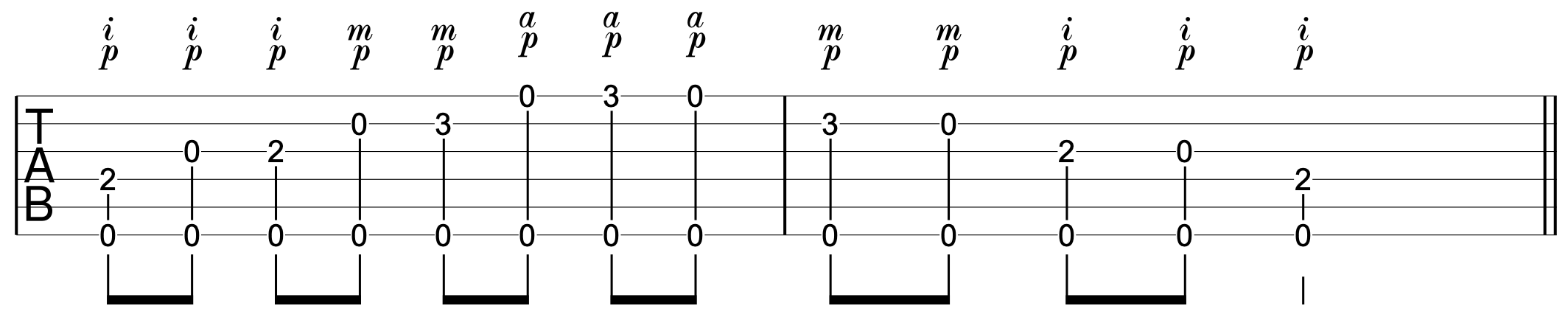
From there, begin separating the two parts. Keep the eighth-note pulse going, but play the bass on the beat and the scale note on the offbeat:
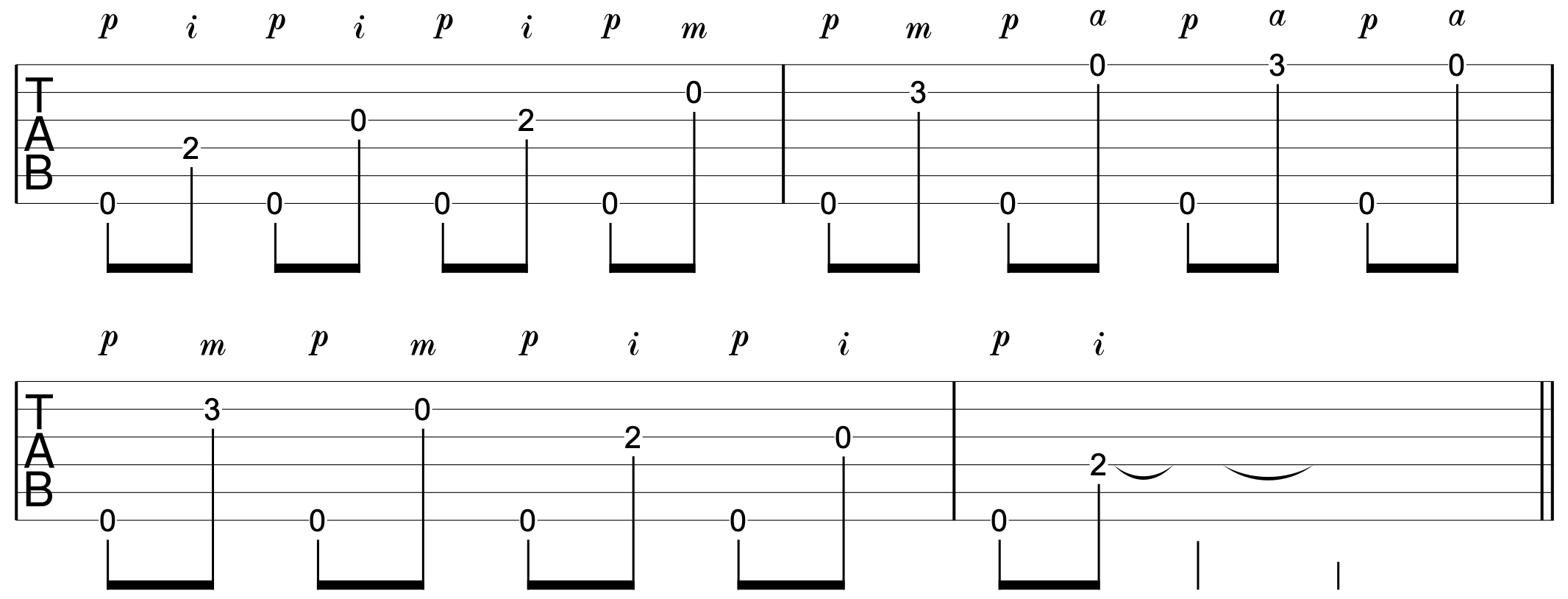
This is where the feeling of independence really starts to develop.
Next, play quarter notes with your thumb while playing the scale in eighth notes with your fingers:
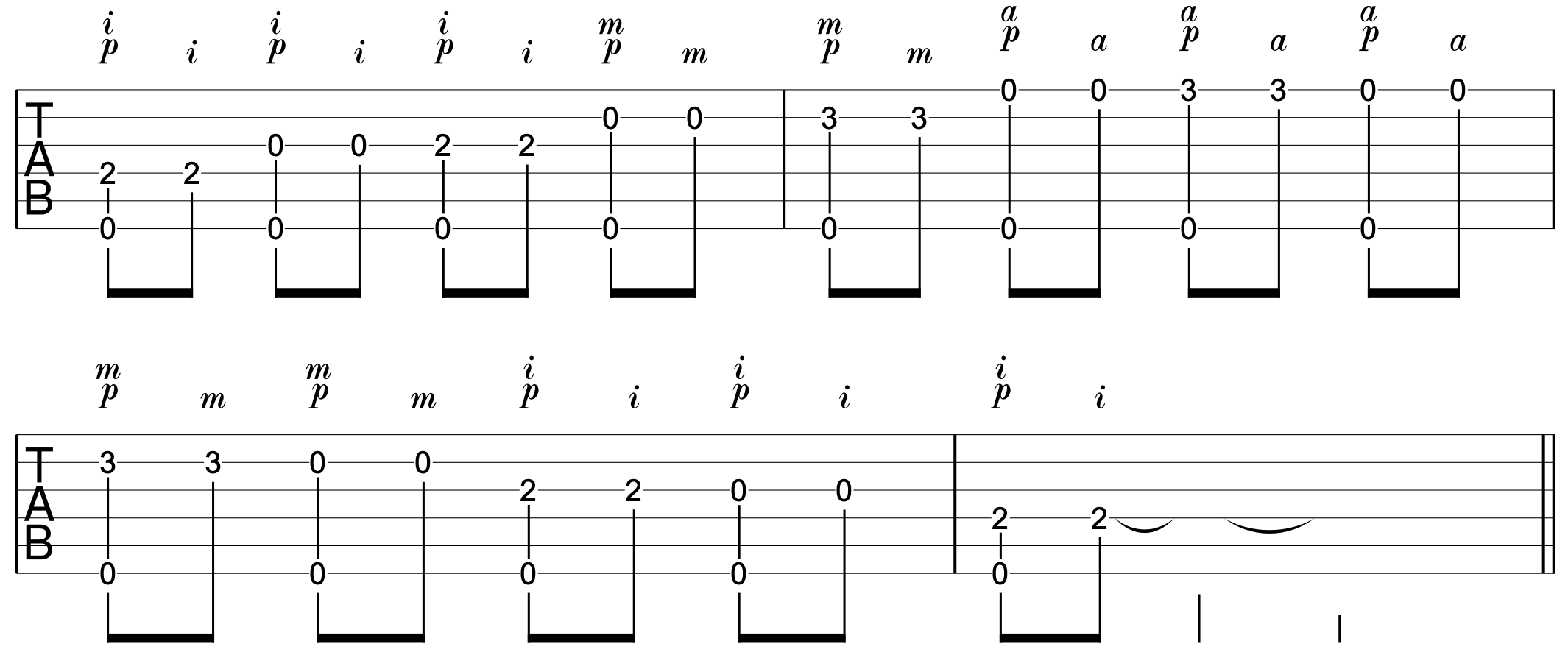
Finally, reverse things: play eighth notes in the bass while the scale moves in quarter notes:
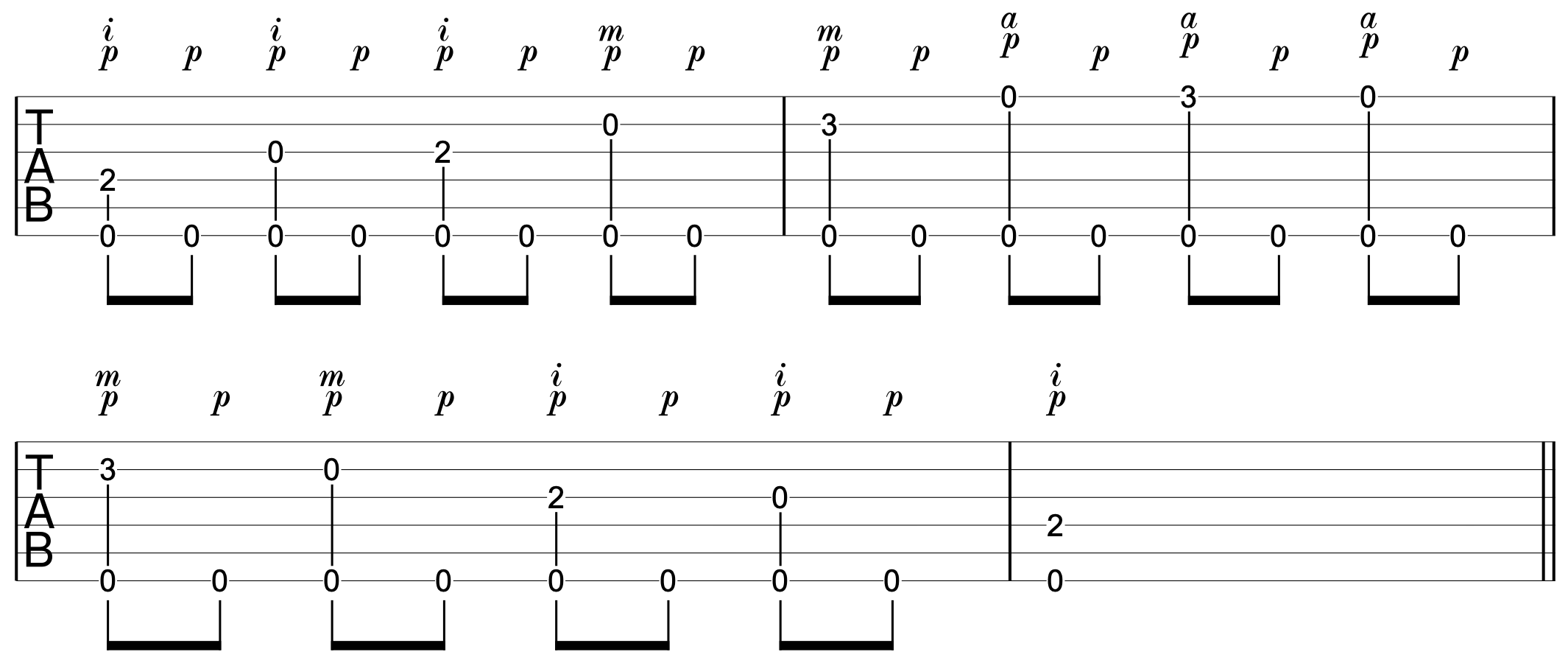
These drills aren’t particularly complicated, and they’re not supposed to be.
Their purpose is to get your thumb comfortable maintaining one rhythm while your fingers do something different.
Don’t rush through them. A steady bass matters far more than speed.
Turning Fingerpicking Exercises Into Music
Technical work is useful, but you don’t want your fingerpicking practice to become an endless collection of exercises.
The exercises need to serve the music.
A simple way to make that happen is to replace the scale with short riffs while keeping the same steady bass underneath.
Take a small riff from the E minor pentatonic scale and play it by itself first. Get comfortable with its rhythm and where it sits against the beat:

Then add quarter notes on the open low E string with your thumb:

Suddenly, that small riff sounds much fuller.
You haven’t made the riff more complicated. You’ve simply put a steady musical foundation underneath it.
Try looping the riff several times. You can also leave a bar of bass between each repetition. This creates some breathing room while helping your thumb stay locked into the fingerpicking rhythm.
Use Different Riffs To Create Variation
Once you can comfortably play one riff against the bass, try another.
It doesn’t need to be dramatically different. A few notes from the same E minor pentatonic scale are enough.
Play the riff alone first, then add the bass.
Here are some examples:
(i)

(ii)

As you build a small collection of these ideas, you begin to have something much more useful than a single fingerpicking exercise. You have several musical phrases that can all sit over the same steady foundation.
Your thumb provides the consistency while your fingers provide the variation.
That contrast is a big part of what makes the guitar sound as though several things are happening at once.
Move Your Fingerpicking Riffs Up the Fretboard
You don’t have to keep your riffs in the open position.
Because the bass is coming from the open low E string, your fretting hand is free to move higher up the neck while your thumb continues playing the same bass.
This immediately gives you much more range.
Try taking a simple pentatonic-based riff and moving it further up the fretboard. Keep the quarter-note bass going underneath it:

The basic idea hasn’t changed, but the result can sound quite different.
You can also vary the rhythm of your riffs. Some might use eighth notes, while others could include triplets or longer notes that ring across the steady bass, like so:

Throughout all of these variations, the bass remains the reliable foundation. That consistency is what holds the fingerstyle groove together.
Keep Your Thumb Steady
As the riffs become more interesting, there’s a natural temptation to focus all your attention on what your fingers are doing.
That’s often when the bass starts becoming uneven.
If that happens, simplify the riff.
Your thumb is the foundation. A very simple riff over a solid bass will usually sound far better than an impressive riff sitting on top of an unsteady groove.
Go back to the earlier drills whenever you need to. They aren’t something you complete once and forget about. They reinforce the coordination that makes the musical examples work.
Then return to the riffs and put that coordination into practice.
Frequently Asked Questions
How do I develop finger independence on guitar?
Start with two very simple parts and practise them separately. Once each feels comfortable, combine them using the same rhythm before gradually giving your thumb and fingers different rhythms to play.
How do I keep my thumb steady when fingerpicking?
Keep the bass part as simple as possible and focus on maintaining an even pulse. If your thumb becomes unsteady when you add a riff or melody, simplify the upper part until the bass feels solid again.
Why is thumb independence important for fingerpicking?
Thumb independence allows you to maintain a steady bass while your fingers play melodies, riffs or different rhythms above it. This can make one guitar sound much fuller without requiring complicated arrangements.
Should I practise fingerpicking exercises slowly?
Yes. Coordination and steadiness are more important than speed. Practising slowly gives your thumb and fingers time to become comfortable with their separate roles before you increase the tempo.
How can I make simple fingerpicking sound fuller?
Adding a steady bass is one of the easiest ways. The bass creates a rhythmic foundation while your fingers play patterns, riffs or melodies above it, giving the impression that several things are happening at once.
Other Lessons You Might Like
Explore these related lessons to continue building your guitar skills:
Beginner Solo Fingerstyle Blues
Put your thumb and finger independence to work in a musical setting by learning how to create a complete solo fingerstyle blues arrangement.
Fingerstyle Blues Rhythm Guitar
Explore another way to bring rhythm, bass and fingerpicking together to create a fuller blues sound on one guitar.
Jazz Blues Chord Progression
Take your blues playing in a different direction with richer chord sounds and a progression that adds more colour to your playing.
Fingerstyle Picking Hand Position
A comfortable and efficient picking-hand position makes it much easier for your thumb and fingers to work independently without unnecessary tension.
Fundamental Fingerpicking Guitar Techniques
Strengthen the essential fingerpicking skills that make steady bass playing, coordination and more musical fingerstyle arrangements easier.
 Build Your Fingerpicking Step by Step
Develop the coordination, technique and musical skills to play fingerpicking guitar with greater confidence and control.