Open String Pedal Triads: The Trick That Makes Small Chords Sound Huge
by Simon Candy
 Most guitarists think of triads as small, neat chord shapes.
Useful? Yes.
Powerful? Sometimes.
But huge, driving, and epic? Not usually.
That changes completely when you start using open string pedal triads.
When you combine simple triad voicings on guitar with a ringing bass note, especially an open string drone, those small shapes suddenly explode into a massive, cinematic sound.
This is a classic triad riff technique used in countless rock songs, and once you understand the concept, you can apply it anywhere.
Watch the full lesson below, or read on for a complete breakdown.
The Core Idea: Use Triads with Pedal Tones
A pedal tone is a sustained or repeated note, usually in the bass, while chords move above it.
On guitar, this often means:
• Letting an open string ring
• Repeating a low bass note
• Keeping one constant bass note while triads move on the higher strings
When you use triads with pedal tones, you create tension and movement without changing the tonal centre.
Instead of thinking:
“I’m changing chords.”
Think:
“I’m keeping one foundation and creating motion above it.”
That shift in thinking is what makes this technique so powerful.
Why Open String Drone with Triads Sounds So Big
There are a few reasons this works so well:
1. The Bass Provides Stability
Your ear locks into the pedal tone.
2. The Upper Triads Create Harmonic Colour
Each new triad changes the flavour without fully shifting the key centre.
3. It Creates a Modal Sound
Because the root stays fixed, the harmony feels expansive and atmospheric.
4. Open Strings Add Natural Resonance
An open string drone with triads produces sustain and overtones that fretted notes can’t replicate.
This is exactly how you make triads sound big, without adding more notes.
Example 1: Pedal A with Moving Triads
A classic rock approach is pedalling an A note in the bass while moving triads above it.
This is evident in the song “Crazy Train” by Ozzy Osbourne.
Here is the excerpt I am referring to:

Conceptually, this can function like:
1 – 5 – 4 – 1
But because the A never stops, it doesn’t feel like traditional chord movement.
It feels like a single, powerful tonal centre with internal motion.
That’s the essence of rock guitar triads in this context.
Example 2: Sliding One Triad Shape Over a Pedal
Another powerful variation of this triad riff technique is keeping the bass constant while sliding one triad shape up the neck.
An example of this is the introduction to “Breaking The Girl” by The Red Hot Chili Peppers:
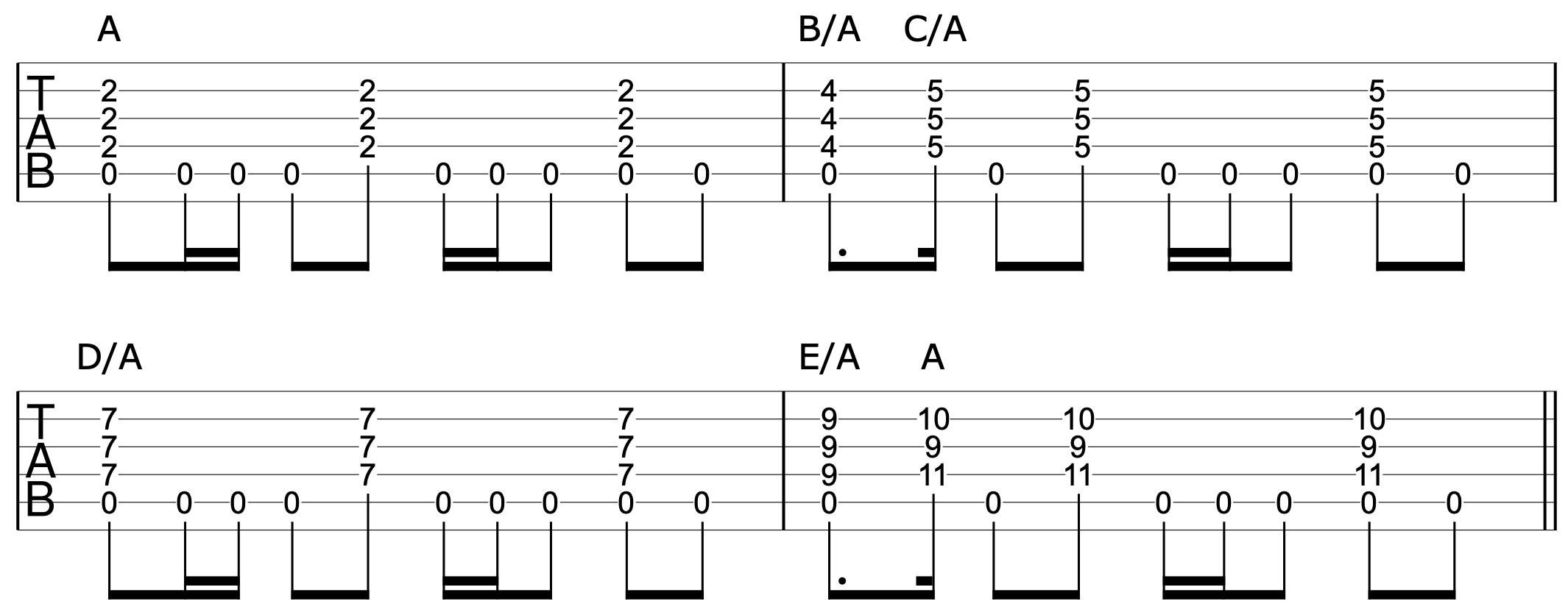
The bass stays fixed.
The shape stays consistent.
Only the position changes.
This creates tension and release while maintaining cohesion.
You’re not changing the foundation, just the colour above it.
How to Practice Open String Pedal Triads
Instead of memorising riffs, extract the concept.
Step 1: Pick a Key
Let’s say A major.
Step 2: Establish an Open String Pedal
Use the open A string and let it ring.
Keep it consistent.
Step 3: Play Diatonic Triads Over It
Now experiment with triad voicings on guitar that belong to the key.
Play each one over the same open A bass, like so:

This is where triads in rock riffs really come alive.
You’re exploring harmonic colour without abandoning the tonal centre.
Expanding the Idea
Once comfortable, try:
• Different triad inversions
• Different string sets
• Minor keys
• Modal sounds (Mixolydian or Dorian flavours work beautifully)
• Different open string drones (E and D are especially effective)
This stops being just a trick and becomes a compositional tool.
Why This Belongs in Every Triads Lesson for Guitar
Most triads lessons on guitar focus on:
• Memorising shapes
• Learning inversions
All important.
But the real magic happens when you apply triads musically.
Using open string pedal triads is one of the most practical, creative ways to do that.
It transforms small chord fragments into powerful, driving textures that work perfectly in rock, acoustic, and modal styles.
The Takeaway
If you remember one thing, let it be this:
Keep a pedal tone in the bass and move triads above it.
That’s it.
That’s how you:
• Make triads sound big
• Create powerful rock riffs
• Add movement without complexity
• Unlock a massive triad sound from simple shapes
Small chords.
Big sound.
All from one simple harmonic idea.
Other Lessons You Might Like
Explore these related lessons to continue building your guitar skills:
The Best Way To Learn Triad Chord Shapes On Guitar
If you want to master triad chord shapes on guitar across the entire fretboard, this guide shows you a simple system for learning and visualising triads in every key. Essential reading if you want to use triads creatively in riffs and chord progressions.
How The Beatles And Pink Floyd Used Triads On Guitar
Discover how legendary bands like The Beatles and Pink Floyd used triads to craft unforgettable guitar parts. This lesson breaks down real musical examples and shows how you can apply the same triad concepts in your own playing.
The Overlooked 2-String Triad Shape That Makes Your Guitar Solos Better
Most players ignore this powerful 2-string triad shape on guitar — but it can instantly improve your phrasing, targeting, and melodic control. If you want to make your solos more intentional and musical, this is a must-read.
 Discover The Magic Of Block Chords For Guitar
Want to go beyond triads? Learn how to use block chord shapes on acoustic guitar to create richer harmony, stronger voice leading, and jazz-inspired movement across the fretboard. This free guide makes complex chord shapes simple and musical.